





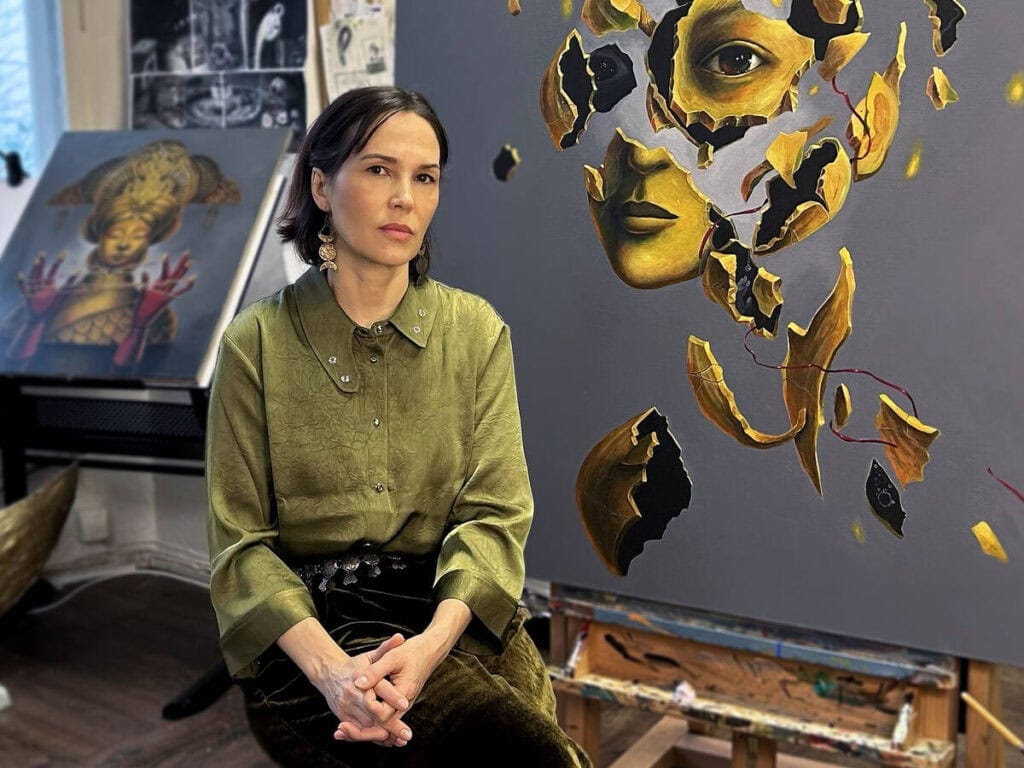
| Artist | Kat Garstka | Resides | Czech Republic |
| Website | katgarstka.art | Medium | Acrylic Digital drawing |
| Print Shop | desamodern.pl/GARSTKA | serpentyna.design@gmail.com | |
| Representing Gallery | Artboxy | Themes | Stylized portrait of a woman Surrealistic portraits of women Sleep as inspiration Focus on the gaze/female eyes Goddesses Symbolism Psychological introspection |
| Follow the Artist | Instagram | Facebook |
About the artist
Kat Garstka was born into a bilingual family and holds dual citizenship, growing up between the neighboring yet distinct cultures of Poland and the Czech Republic. This experience of duality shapes both her identity and artistic practice, influencing her fusion of traditional painting with modern digital techniques. Working primarily on canvas, Kat focuses on portraiture, building her figures through layered glazes that begin with monochromatic modeling reminiscent of medieval egg tempera methods. Using contemporary acrylic paints, she creates delicate semi-transparent layers that bring depth to her surreal portraits of women. Her work also engages with art history, sometimes reinterpreting Old Master paintings, as seen in her series To Be Like Mona Lisa. Expanding beyond the canvas, Kat incorporates augmented reality (AR) animation, adding new dimensions that transform her paintings into immersive, evolving experiences.
Kat does not limit herself to specific programs when creating her animated elements. Instead, she works fluidly across both 2D and 3D animation software, combining different tools to deepen the intellectual narrative that accompanies the characters she paints. Her creative direction is guided by another compelling duality: a fascination with dreams, the subconscious, alchemy, ancient mysticism, and shamanic traditions alongside Eastern spiritual philosophies such as Buddhism and Taoism, contrasted with her interest in contemporary scientific fields like quantum physics, neurobiology, and psychology. While these areas may appear to sit at opposite ends of the spectrum, Kat is drawn to the insights each offers about human consciousness, selecting meaningful ideas from both realms to better understand the complexities of personality.
For Kat, painting functions much like a personal notebook. Each canvas becomes an extension of her reflections across time and space, capturing the thoughts and conclusions she arrives at through her creative process. She approaches painting as a form of contemplation, valuing a clear and curious mental state while continually questioning the nature of human identity. Her imagery often draws from dreams, meditation, and symbols emerging from the subconscious, referencing the spiritual pursuits of alchemists, Buddhist monks, and shamans. At the same time, she is equally inspired by the empirical exploration of the human psyche through Jungian psychology, as well as by insights from quantum physics and the biochemical processes that influence the workings of the human mind.
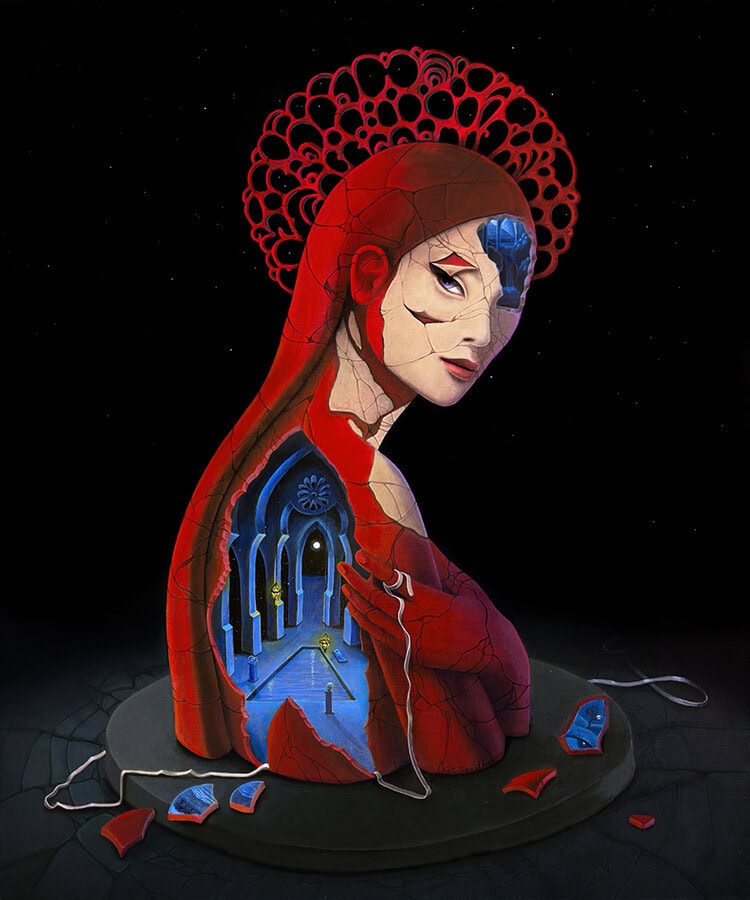
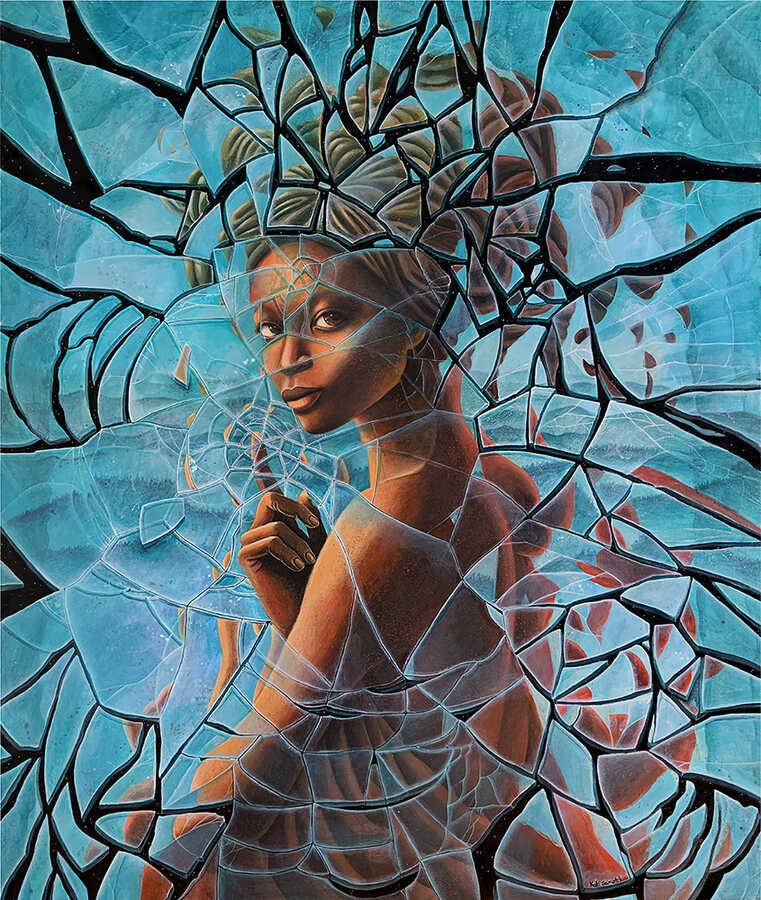
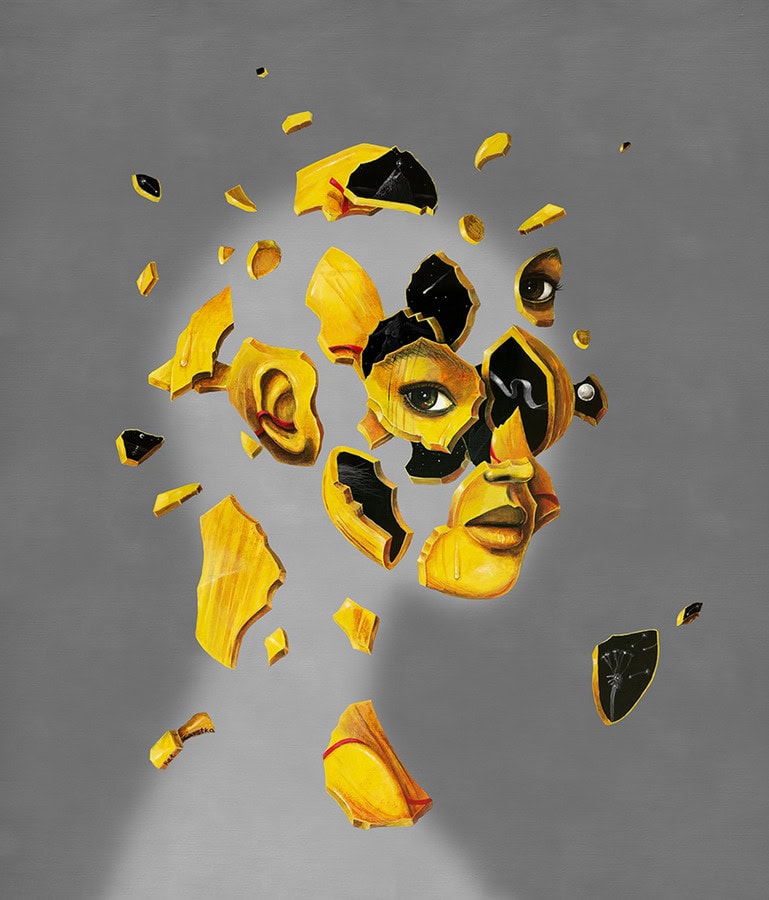
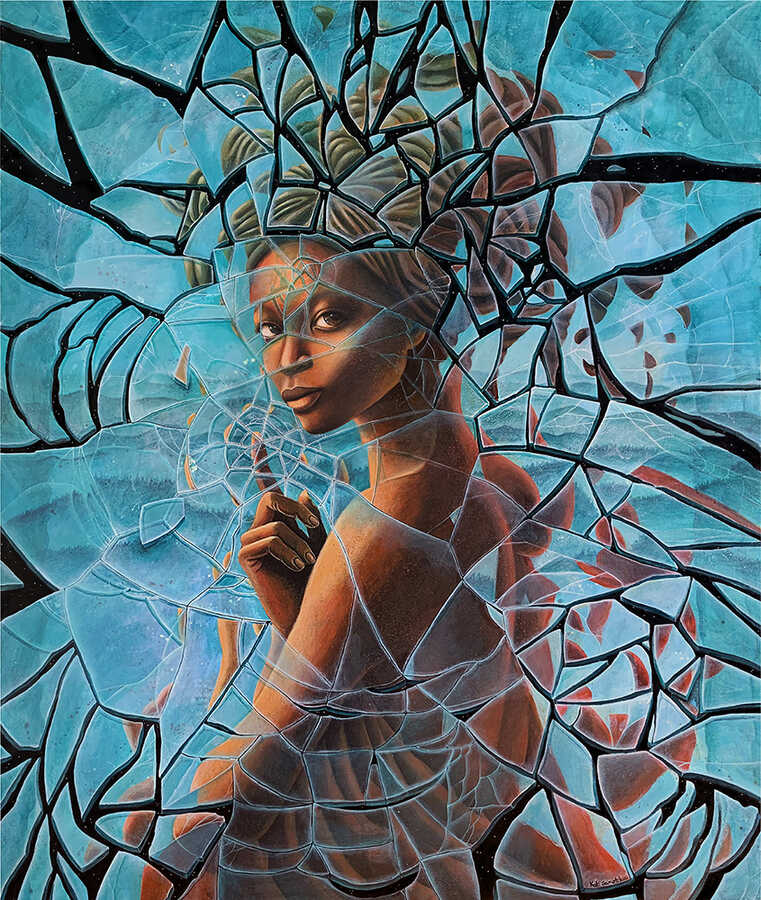
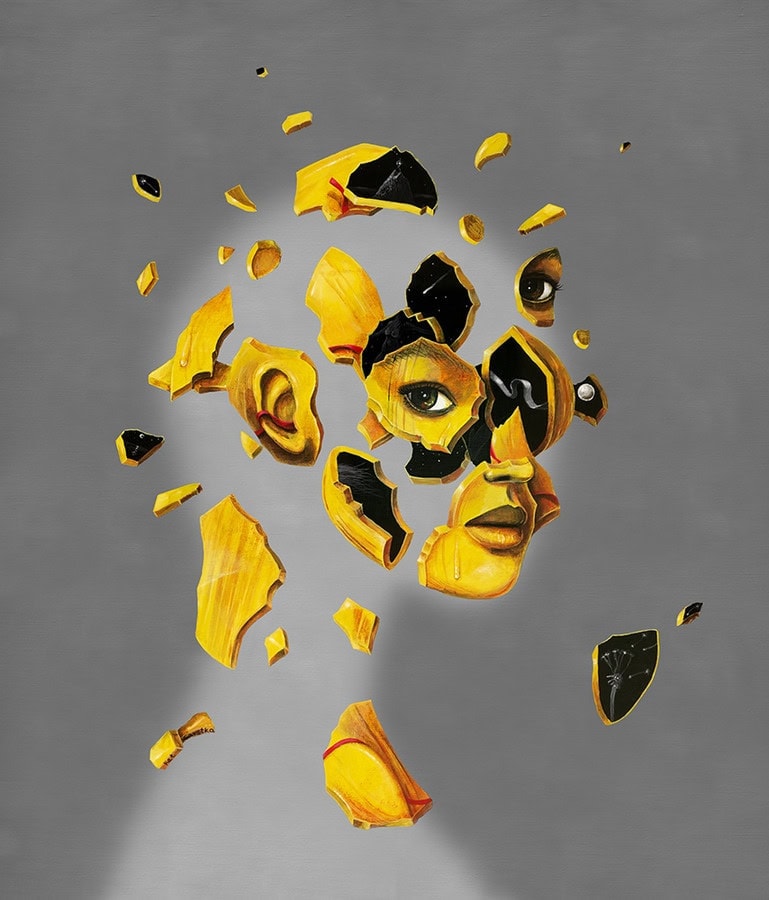
Both of these paths converge in Kat’s portraits of parallel beings — figures that seem to emerge from a dreamlike subconscious and quietly contemplate their existence within a kind of quantum space. Each painting becomes a chapter in a visual diary, created with brush on canvas, documenting fragments of her ongoing exploration of the human psyche. Through these characters from imagined dream worlds, Kat asks fundamental questions about identity, who we are, or who we believe ourselves to be. She often depicts her figures within broken mirrors, symbolizing the fragmentation of the ego, or places them within abstract spaces inspired by quantum equations. In her paintings, the present moment feels suspended in a timeless realm where the fourth dimension – time, is absent, allowing both the figures and the viewer to reflect together. Kat also plays with scale and perception, composing works that can be appreciated from afar while concealing small details, enigmatic scenes, or miniature landscapes that invite closer inspection. This movement between macro and micro perspectives echoes the ancient principle from the Tabula Smaragdina: “That which is below is like that which is above, and that which is above is like that which is below.”
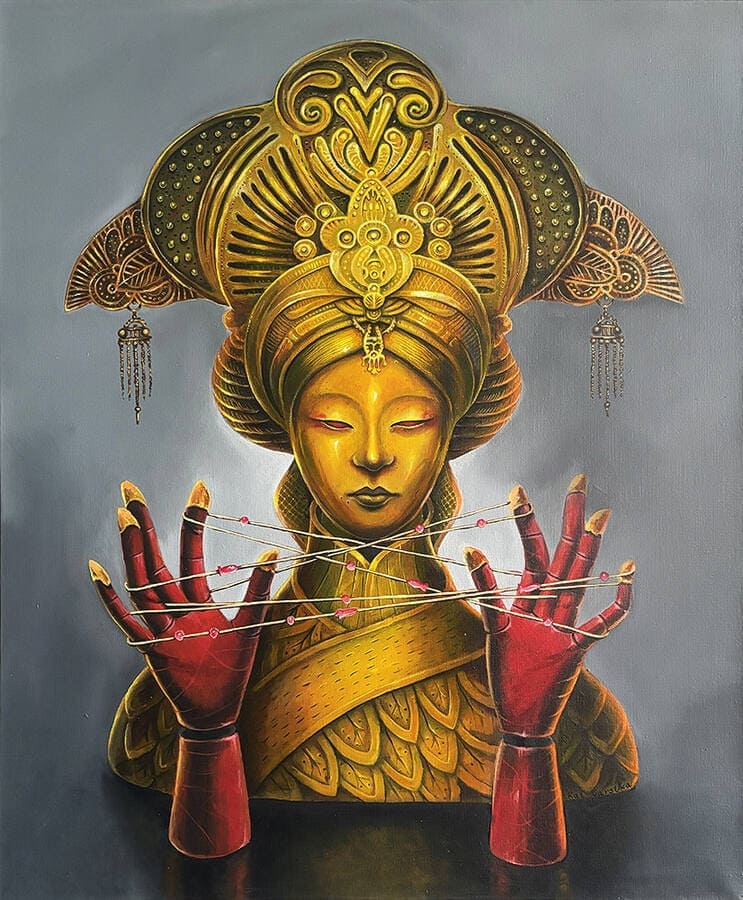
Kat Garstka aims to draw viewers into an intellectual puzzle through the mesmerizing gaze of her figures, most of whom are women. Through these characters, she tells subtle stories or captures quiet moments of transition and awareness — reflections of the psychological states her subjects inhabit. A central duality within her work lies in the pursuit of beauty alongside the creation of paintings intended for contemplation. Beauty invites the viewer in, while mystery and layered symbolism encourage deeper reflection. In a time when traditional ideas of beauty in art have been deconstructed and liberated from strict cultural or religious canons, Kat seeks her own path to defining it. She often explores beauty through the image of a woman’s face — an echo of one of humanity’s earliest emotional imprints: the face of a mother. For Kat, female faces carry psychological depth and emotional language, which is why they appear so frequently throughout her work.
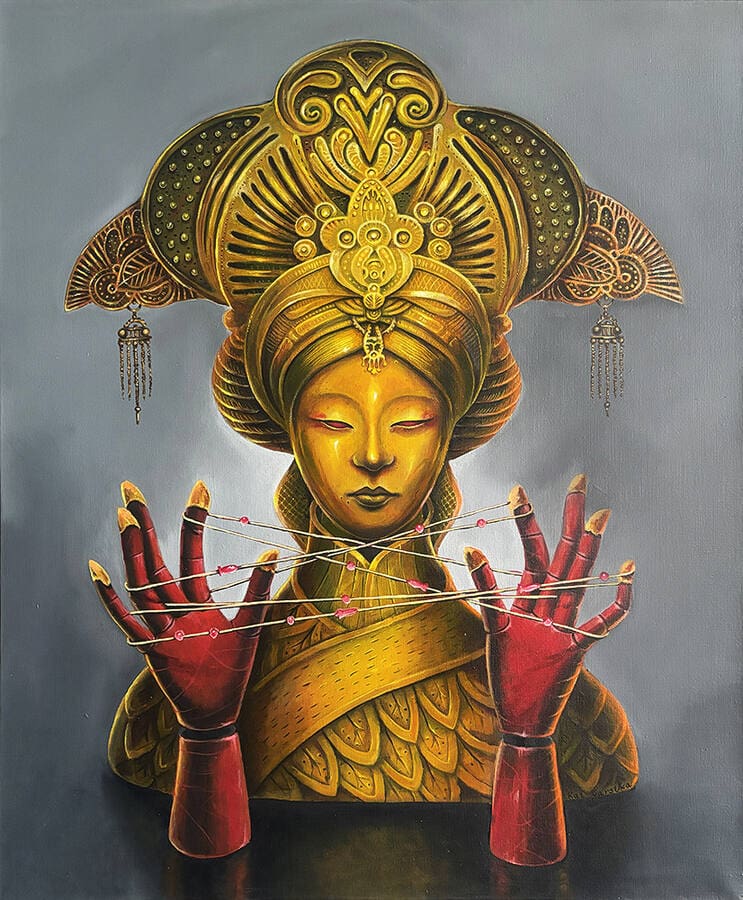
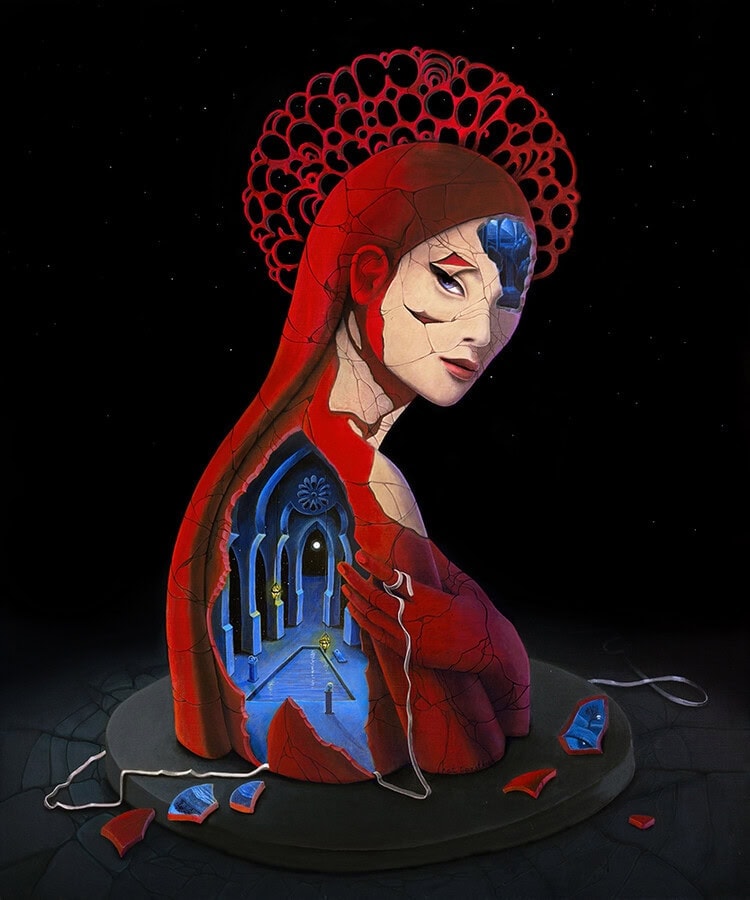
Symbols play a significant role in her visual storytelling, reflecting her interest in Hermetic philosophy and ancient spiritual traditions. Like condensed keys to deeper meanings, these symbols invite viewers to uncover layered associations within the paintings. Pearls, for instance, appear often in her work and historically symbolize hidden spiritual knowledge, wisdom, and purity. Mirrors represent self-observation, while broken mirrors suggest the fragmentation or deconstruction of the ego. Other recurring elements include a red ribbon, associated in Eastern mythology with fate and the thread of life — and falling drops of water that evoke mindfulness and awareness of the present moment. Kat also introduces symbolic figures such as stone goddesses from her own imagined mythology, envisioned as artifacts discovered in the near future on planets and moons within our solar system. These goddesses embody feminine wisdom and the transmission of secret knowledge. Through surreal portraits and symbolic visual narratives, Kat ultimately constructs psychological portraits of the enigmatic beings who seem to visit her dreams from parallel worlds.
Artwork Themes & Subject Matter
Kat Garstka’s paintings center on surreal portraits of women, through which she explores the psychological depth of her characters. Using symbolism and layered visual spaces, she constructs complex inner worlds that reflect the emotional and mental states of her subjects. A figure may appear with an inner landscape or garden unfolding within her, or be seen through the reflection of a breaking mirror, suggesting introspection and transformation. The woman’s face, her mesmerizing gaze, and symbols that invite contemplation form the core motifs of Kat’s work. During exhibitions, these paintings are further expanded through augmented reality (AR) animations, allowing the imagery to move beyond the flat, static surface of the canvas and into a dynamic, immersive dimension.
Upcoming Exhibitions
| When | Exhibition | Gallery |
| April 2026 | Solo exhibition: ‘Parallel beings, paintings and AR animation‘ | Jáma10 gallery Ostrava, Czech Republic |
| April 2026 | Group exhibition: ‘Pre-auction group‘ | Gallery Skicak, Prague, Czech Republic |
CV
Education
2004
Defence of master’s thesis in painting in the studio of Prof. Ryszard Woźniak, Institute of Art, University of Zielona Góra
2002–2004
Institute of Art, University of Zielona Góra
1997–2001
European Academy of Arts, Warsaw
1996
Secondary School of Fine Arts – Painting, Ostrava, Czech Republic
Selected Solo Exhibitions
2023
Works, DAF – Discovery Art fair Cologne, Cologne, Hermany

Inkographs and Paintings, Warsaw Artists, Warsaw, Poland
Selected Group Exhibitions
2025
Pre-auction group exhibitions in auction house, Galerie SKICAK, Prague, Czech Republic
2022,
ReWizje, collective exhibitions, Gallery “Pod Okiem”, Warsaw, Poland
2019-2026 (36 exhibitions)
Pre-auction group exhibitions in auction house, DESA UNICUM, Warsaw, Poland